

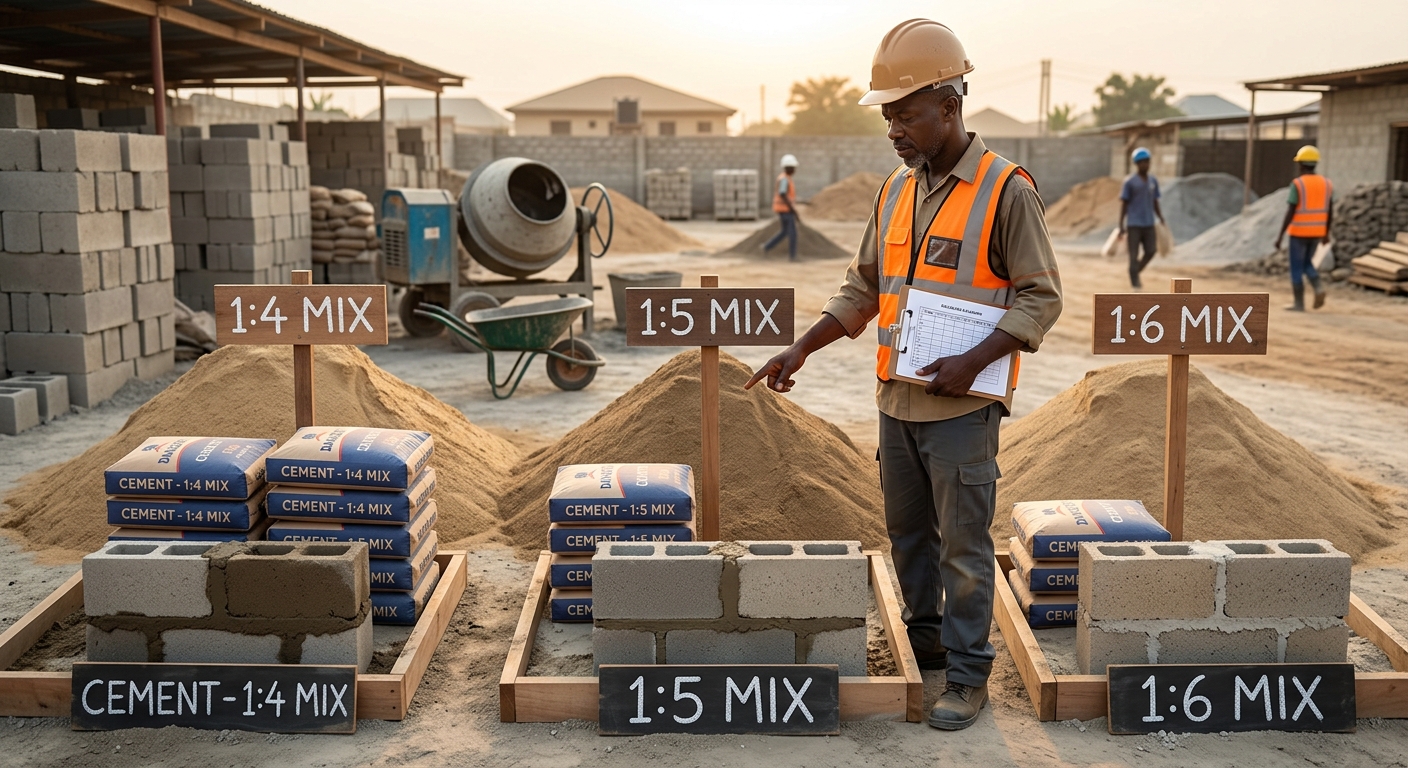
1:4, 1:5 or 1:6 Mortar Mix: What Changes in Your Material Estimate?
When running a material estimate for blockwork or plastering, specifying the mix ratio isn't just a structural detail, it is the single biggest lever controlling your cement budget.
Moving from a 1:4 to a 1:6 mortar mix might seem like a minor tweak on paper. In reality, it completely shifts your material quantities, structural performance, and overall project cost.
Understanding the Ratios
In any batch, the ratio represents one part cement to N parts sand by volume:
- 1:4 Mix (Rich): High compressive strength, excellent bond adhesion, and superior water resistance.
- 1:5 Mix (Standard): The middle ground balancing workability, strength, and cost.
- 1:6 Mix (Lean): Highly economical, but produces lower bond strength and higher porosity.
How the Material Quantities Shift
Because sand fills the bulk of the mortar matrix, shifting ratios drastically changes your cement consumption, while sand requirements remain relatively stable per cubic meter of finished mortar.
Accounting for dry volume shrinkage (using a standard factor of ~1.33 for voids and wet compaction), here is how a 1 m³ dry mortar estimate shifts across ratios. All bag counts below assume the standard 50kg cement bag; if you're working with a different bag weight (e.g. 40kg or 94lb), rescale these figures accordingly before using them in your estimate.
- 1:4 Mix: Requires roughly 7.6 to 8.0 bags (50kg) of cement per m³.
- 1:5 Mix: Requires roughly 6.3 to 6.6 bags of cement per m³.
- 1:6 Mix: Drops to roughly 5.3 to 5.5 bags of cement per m³.
Moving from a 1:4 mix down to a 1:6 mix slashes your total cement requirement by nearly 30%. On a medium to large project requiring hundreds of square meters of plastering, that difference translates to dozens of bags saved.
The Trade-Off: Where Each Mix Belongs
While a 1:6 mix lowers your material bill upfront, using it in the wrong area causes costly failures like hollow plaster, dusting, and moisture seepage.
- Where to use 1:4: External wall rendering exposed to harsh weather, damp environments (bathrooms, basements, manholes), retaining structures, and heavy load-bearing blockwork.
- Where to use 1:5: Standard internal wall plastering, regular load-bearing blocklaying, and floor screeds.
- Where to use 1:6: Internal partition walls under light loads, temporary structures, or base leveling coats in dry areas.
The Estimator's Takeaway
Never default to a single mortar ratio across an entire bill of quantities. Over-specifying (using 1:4 everywhere) inflates your material budget unnecessarily, while under-specifying (using 1:6 on exterior faces) leads to cracked walls and rework. Group your material takeoff by exposure and structural load so your estimate remains lean, accurate, and durable.